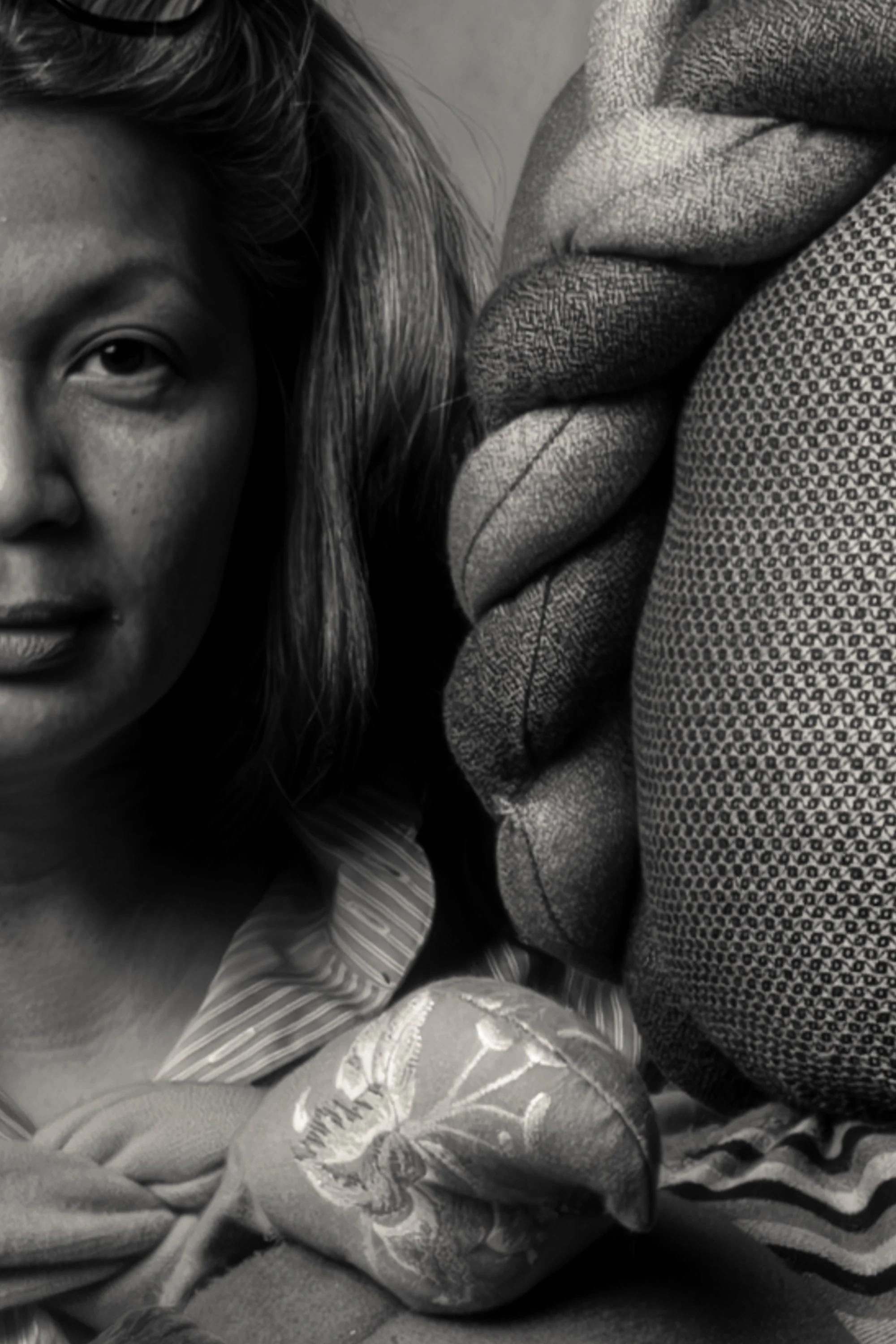
Ava Mikael
Ava Mikael
Philippine‑born, UK‑based artist (sculptor, writer, painter)
Ava Mikael’s practice arises from the recognition that art is a living dialogue between the seen and unseen worlds. Her textile sculptures—giant maternal deities, dreaming figures, and revelatory dolls—stand as intermediaries between matter and spirit, inviting the viewer to encounter tenderness as a force of transformation.
For Mikael, cloth is not a passive material but a vessel of vitality. She sew-sculpts British Tweed, Tartan, Scottish cashmere, Philippine weaves, European fabrics and Asian textiles into breathing forms that bridge landscapes and lineages. Each sculpture begins as a revelation: an image seen inwardly long before it becomes tangible. Sculpting is an invocation, a process through which thread, color, and weight translate messages from the higher world into form.
Her early years were rooted in the Philippines among storytellers, prayerful elders, and folk rituals where myth and daily life intertwined. These were not metaphors but living presences—moments when the spiritual world made itself felt through gesture and color. Like many Filipinos, she grew up in a culture where Spirit is not a theory but an atmosphere—sometimes gentle, sometimes storming through the room. This immediacy of the invisible became the ground of her art.
Encounters with indigenous craftsmen, trauma healing, and Rudolf Steiner’s spiritual science later gave her language for what she had always sensed: that creation is a dialogue between visible and invisible agencies. Over two decades she developed what she calls Surgo Misteros—The Rising of the Mysteries—a luminous evolution beyond postmodernism’s irony, kindred to the visionary rediscoveries that placed fellow Anthroposophy artists such as Hilma af Klint back into modern consciousness: disciplined mysticism rendered in material form.
Mikael’s migration to Britain marked an alchemical turn. In the English and Scottish textiles—tweed, damask, wool— she discerned echoes of the same spiritual craftsmanship native to Southeast Asia. “Great Mother Albion,” the monumental green goddess born of this meeting, crowns her transition from local myth to universal archetype: the mother as the bridge between matter’s gravity and spirit’s ascent.
Her ongoing projects, The Realm of the Mothers and The Museum of Fabric Fairytales, extend this vision into public and communal life. They propose art as re‑enchantment, a restorative act that can renew civic as well as inner architecture. The Mothers, dolls, and stories she births are not nostalgia but prophecy—signs that the sacred feminine still breathes, waiting for humanity to remember.
Ava Mikael lives and works mainly within the United Kingdom but she also shuttles between Europe and Asia. Her work suggests that the next era of art, after irony and exhaustion, begins with the courage to think while feeling again.